


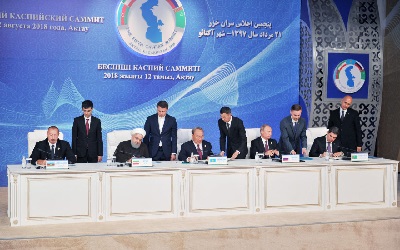
On August 12, the Presidents of Russia, Kazakhstan, Iran, Azerbaijan and Turkmenistan signed the Convention on the status of the Caspian Sea.
 Work on the Convention has lasted since 1996, and its project was finally adopted at a meeting of Foreign Ministers of the Caspian countries in Moscow on December 4-5, 2017.
The Caspian Sea is the sea or the lake. On the eve of the Aktau summit, Russian Deputy Foreign Minister Grigory Karasin explained that the Caspian Sea would not be considered a sea or a lake. According to him, this reservoir will have a special legal status. This is explained by a set of specific geographic, hydrological and other characteristics. The Caspian is an inland water body that has no direct connection to the world’s oceans, and therefore cannot be considered a sea. But at the same time, due to its size, water composition and bottom features, the Caspian cannot be considered a lake. In this regard, the provisions of the United Nations Convention on the Law of the Sea of 1982 and the principles applied to trans-boundary lakes are not applicable to the Caspian Sea.
Division of the water area and the bottom of the Caspian Sea. According to the Convention, the water area of the sea shall be delineated into internal waters, territorial waters (not exceeding 15 nautical miles in width, the sovereignty of the coastal state extends over this sea area, and its outer border is considered a state border), fishing zones (10 more miles, within which the state has an exclusive right to fish) and the general water area. Thus, a large part of the water area and biological resources of the Caspian Sea remains in common use.
It should be noted that according to the 1995 Constitution of Azerbaijan, the Azerbaijani sector of the Caspian was considered an integral part of the country. According to the signed Convention, the state border of Azerbaijan in the sea already narrows to 27 km from the coastlines.
Plots of the bottom and subsoil should be divided into national sectors. Disagreements over the division of the bottom of the hydrocarbon-rich reservoir have long been one of the main obstacles to the adoption of the Convention. Over the period since the collapse of the Soviet Union, Russia, Kazakhstan, Azerbaijan and Turkmenistan have agreed on delimitation of the seabed and shelf of the northern part of the Caspian Sea using the “modified middle line” method.
However, Iran did not like such a model, since in that case it accounted for only 13% of the shelf, while Tehran demanded to divide it equally (that is, 20% for each country). Currently, on the division of the Caspian seabed, there remains an acute problem between Azerbaijan and Iran, between Iran and Turkmenistan, as well as between Azerbaijan and Turkmenistan.
The Convention, however, does not fully clarify the issue of the demarcation of the bottom. It only says that “the delimitation of the seabed and subsoil of the Caspian Sea into sectors is carried out by agreement between neighboring and opposing states, taking into account universally recognized principles and norms of law.”
Deputy Minister of Foreign Affairs of the Russian Federation Grigory Karasin made it clear that Moscow would prefer that Azerbaijan, Iran and Turkmenistan resolve disputes on subsoil in a bilateral or trilateral manner, without pulling all the “five” into them.
The implementation of the Trans-Caspian pipelines. The Convention clarifies one of the key issues that had previously caused serious disputes between the “five”.
The document clearly states that countries can lay pipelines along the bottom of the Caspian Sea, and this requires the coordination of only the party through whose sector it will pass. Their neighbors only need to be notified of the pipeline routes. Thus, this formally opens the door for the construction of the Trans-Caspian gas pipeline from Turkmenistan to Azerbaijan or the Trans-Caspian oil pipeline from Kazakhstan to Azerbaijan.
However, according to Russian sources, together with the Convention, a protocol was signed on the procedure for assessing the environmental impact of projects. According to the document, for the construction of pipelines along the Caspian seabed, the consent of all coastal states is required. Thus, Russia and Iran will receive an instrument that could at least delay the possible construction of pipelines in the direction of Azerbaijan.
Military cooperation in the Caspian. The Convention included a provision on the “non-presence” of the armed forces of third countries in the Caspian. The Caspian states also undertake not to provide their territory to anyone “for the commission of aggression and other military actions against any of the contracting parties.” And it is also about the establishment of a monopoly on any seafaring exclusively under the flags of the five signatory countries.
The signatories also agreed on the rules under which shipping, fishing and scientific research will be carried out.
Also, the participants of the summit in Aktau signed documents on cooperation in the trade and economic sphere, as well as in the issue of transport.